

In my work in the criminal legal system, especially when persistently wicked problems1 arise, many of my colleagues focus on all the reasons something won’t work. They talk about all the barriers and constraints, all the things they’ve tried before, and how this new attempt is a waste of time.
I often hear, “Just wait it out,” because leadership or legislative changes are destined to make any progress futile. Another common phrase is, “Don’t drink the Kool-Aid,” which allows people to do absolutely nothing and then say, “I told you so,” when things fail. These folks love to point out all the things that could go wrong, which, in the justice system, usually involve budget money, the headlines, more crime, or all three.
When that perspective is challenged by people like me, someone who is trying her damndest to be an optimist in the hopes of creating some tangible change in a broken system, the response is usually something like, “I’m not a pessimist. I’m a realist.” Other people in the room will nod, because that sounds logical and mature, and I’ll be left standing in the corner with the other misfits who are labeled as naive.
The book on resilient optimism is coming soon! Sign up for the pre-order list on my website here.
I’ve been accused of being naive for most of my life. For the longest time, I believed it. My formative years were in Canada, and my parents were strict. I didn’t have the same schooling or experiences as my high school and college peers in America. When I didn’t understand what the other kids were saying, I chalked it up to my upbringing, but once I was well into my 30s, I began to see that it was more than that. It wasn’t that I was Canadian (eh!) or naive. I came to learn that I was resiliently optimistic™. I started to see realism for what it really was, too: Resignation.
About that Glass of Water…
I recently read this analogy: An optimist sees the glass as half full. The pessimist sees the glass as half empty. The realist sees the glass with water to drink.
What I like about this age-old analogy, with a twist, is how it frames pessimism, optimism, and realism as mindsets. You aren’t a pessimist. You have a pessimistic point of view. You aren’t a realist. You have a realistic point of view. You aren’t even an optimist. You have an optimistic point of view. Right?
But the trouble with the glass-of-water analogy and the generally accepted thinking around realism is that it assumes pessimism and optimism are somehow wrong and that the realistic point of view is objective and correct. And that’s a problem, seeing how objectivity is an illusion.

Naive Realism
You likely believe you see the world exactly as it is, but research into naive realism suggests otherwise. Social psychologists argue that your personal perspective accounts for only about 10% of what is actually happening in any given situation, even though you might feel like you have 100% of the information2. This cognitive bias leads you to assume that anyone who disagrees with you is uninformed or irrational.
When you adopt the resiliently optimistic mindset, you acknowledge that you see reality as you are, shaped by your own biases, emotions, and past traumas, rather than seeing the world exactly as it is in its entirety. You take a pause and consider the other possibilities.
In the corrections system where I have worked for almost 30 years (gawd, I’m getting old), the realistic (and predominant) “it is what it is” mindset has led to little or no meaningful change, because those working in the system assume they know how the story ends. The program won’t get funded. The guy will only end up back in prison. The drunk driver will never get sober.
To me, that’s not realism. That’s pessimism. Leaning on this approach doesn’t offer a path forward. It doesn’t expand the conversation or invite new thinking. It simply reinforces what already exists.
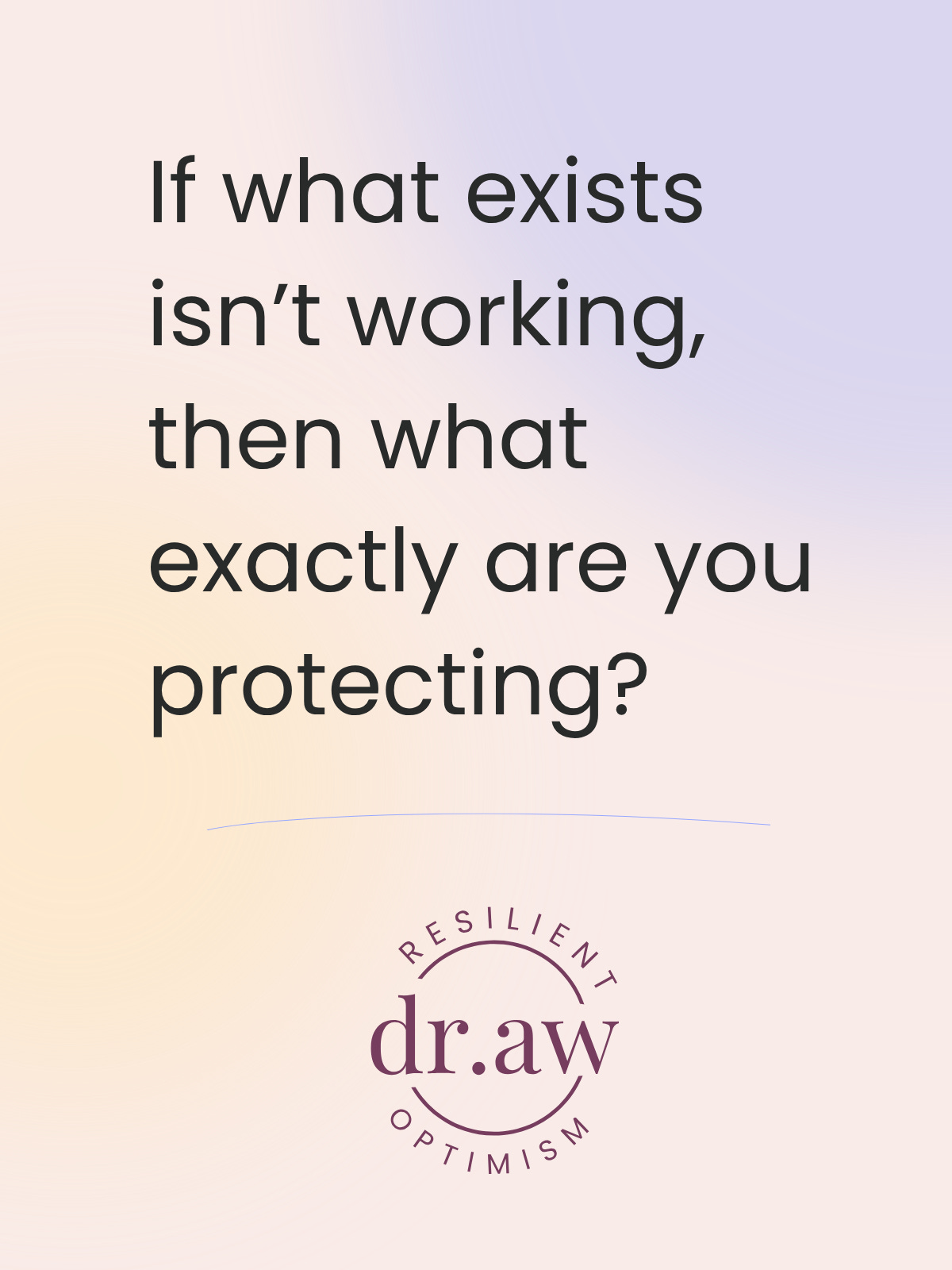
And if what already exists isn’t working, then what exactly are you protecting?
Why Your Brain Wants You to Be Pessimistic
The human brain is designed to seek certainty, efficiency, and energy conservation. It does this through heuristics, or mental shortcuts, to reduce the cognitive effort required to make decisions and react. Heuristics are a gift because they help us avoid car accidents and conserve energy so we have enough mental space at the end of the day to play Block Blast. (My co-author is at 350,159 points, people!)
The trouble is, all this quick thinking leans on cognitive biases that can lead to irrational judgments and missteps. All this quick thinking is by design to keep you safe and sound, which means staying home and avoiding risks.
Who changes the world that way?
In a future Substack, I’ll talk about how understanding and counteracting cognitive biases is fundamental to becoming a resilient optimist. But for now, just know that you always need to take a pause, ask more questions, consider other points of view, and accept that you only know 10% of the facts, not anywhere near the 100% you assume you know.
I’m Part of the Problem
Pessimism, especially the kind that hides behind realism, has a narrowing effect. It scans for everything that could go wrong. It builds a case for why change is unlikely. It simplifies complex problems into fixed truths. And then, without much effort, it shuts things down.
There’s no room left for curiosity or space to explore. Just a convincing argument for staying exactly where you are. And here’s the part that’s uncomfortable for me to admit: I do this too.
There are moments, especially when I’m deep in exhaustion, frustration, fear, and defeat (what I refer to as EFFD), where I can feel myself slipping into that mindset. When I’m EFFD, I know it because I have a recurring set of limiting beliefs that show up:
The criminal legal system is too big and too powerful to change
The system and its people are too broken
Some people are simply unmovable
Politics and personal agendas are too powerful
There are a million things that would have to change before this one thing ever could
In the moments when these thoughts or versions of them show up, it feels like clarity. Like I’m finally seeing things for what they are, and that the only way forward is to give up and move on. But if I slow down and really look at it, I can see that something else is happening. I’m not being realistic. I’m choosing pessimism.
I’m choosing the comfort of being right about why something won’t work over the discomfort of trying something different that might. This thinking becomes a self-fulfilling loop, too. I decide nothing will change, so I disengage from the project, committee, or whatever it is that I have on my plate. Then, when things inevitably stay the same, it reinforces my original belief. See? Nothing works.
And that resignation feels good. I get to go to my work buddies and talk trash about the people and plan that I had disengaged from. Now, not only have I succumbed to the realist trap, but I’ve also chosen to get my dopamine hit from gossip and whining instead of doing the hard work.
Logically, I know my biases and heuristics are at play, but still, when I resign myself, I have to own something I don’t particularly like to admit…I am part of the problem.
Are you?
How Resilient Optimism Fills the Glass of Water to the Brim
Resilient optimism operates differently than the traditional optimism we are all familiar with. It is more than half a glass of water.
Resilient optimists are grateful for that water, but they want more than that little bit. They want a well filled with water, big enough to offer water to everyone involved. They aren’t going to be persuaded from the effort to get it, either. Even by setbacks that would cause others to quit.
Remember, resilient optimism doesn’t deny reality. It’s not naive. It doesn’t ignore constraints or pretend things are easier than they are.
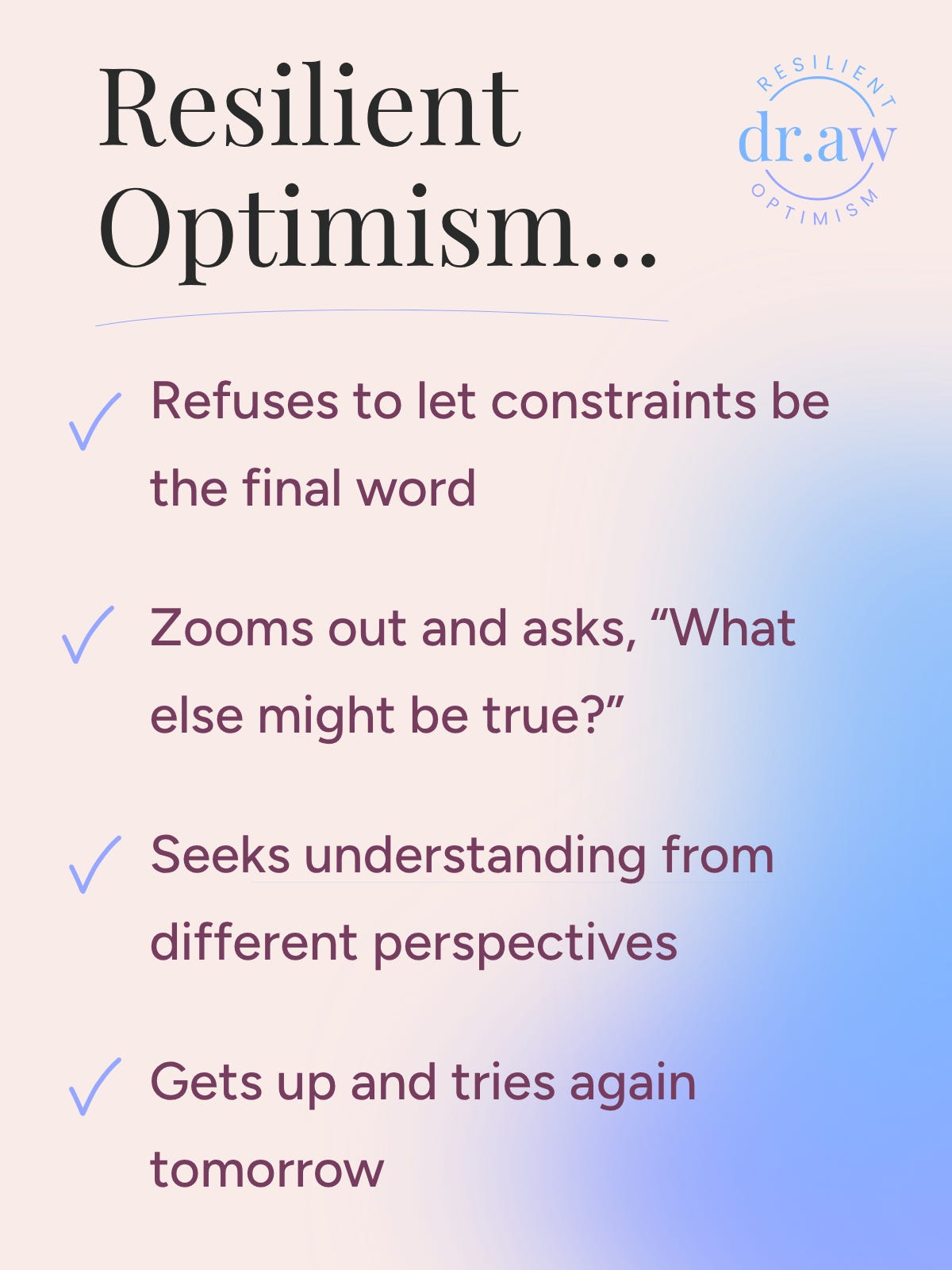
Here’s what resilient optimism does:
Refuses to let constraints be the final word
Zooms out and makes room for questions like, “What else might be true?”
Seeks understanding from people and places that offer different perspectives
Gets up and tries again tomorrow
Resilient optimism helps you to be more creative and see more possibilities. Learn more about it here.
The Invitation
Whatever you call it—pessimism, realism, practicality—it eliminates your agency. With it at the wheel, outcomes will remain the same. Systems stay broken. People struggle with their work to the point of burnout. Vulnerable populations are stuck in unhealthy cycles.
That’s why resilient optimism matters.
If you want to stay engaged in shaping what could be in systems like government, healthcare, education, or even in your office or home, I invite you to let go of realism.
Can you instead choose, again and again, to stay open, even when it is unrealistic?
The term “wicked problem” was coined in 1973 by design theorists Horst Rittel and Melvin Webber to address challenges that lack clarity and are subject to real-world constraints. It’s a term often used in leadership development circles. https://www.stonybrook.edu/commcms/wicked-problem/about/What-is-a-wicked-problem
Ross, L., & Ward, A. (1996). Naive realism in everyday life: Implications for social conflict and misunderstanding. In E. S. Reed, E. Turiel, & T. Brown (Eds.), Values and knowledge (pp. 103–135). Lawrence Erlbaum Associates, Inc. https://psycnet.apa.org/record/1996-97682-006