

There was a period in my career when I started hearing myself say things that didn’t sound like me. I remember sitting in a meeting, talking about a client and hearing myself assume his failure, which, when you work in corrections, usually means a journey back to prison. I don’t remember the exact words anymore, but I remember the feeling underneath my words: futility. Trying to help him felt pointless.
A few people in the room, who I had been working with for years at that point, looked at me strangely, almost as if they were trying to figure out where the old Alex had gone. And then I noticed one of the most cynical people in the room nodding in agreement. He looked satisfied.
Ugh. That moment hit me like a good old-fashioned cold plunge. I remember leaving that meeting wondering, “Is this who I am now? Have I become the cynical person working the criminal/legal system who doesn’t believe people can change?”
At the time, I didn’t have language for what was happening. I just knew it was an all-around heavy feeling that I was carrying around. I felt less hopeful. I still cared about my work, maybe too much, but where I used to instinctively look for pathways forward, I found myself focusing on obstacles. Where I once saw possibility in people, I started predicting outcomes. Perhaps the most unsettling part was that it all felt justified, as if I had seen and experienced enough to know the future.
I Was Still the Same Ol’ Alex, But I was EFFD
Now, with some distance and a much deeper understanding of stress, burnout, and mindset, I have language for what was happening to me back then. I was still the same person. I hadn’t turned into a disgruntled government worker. My mindset needed a reset because it was EFFD:
Exhausted,
Frustrated,
Fearful, and
Defeated
In my experience, if you stay in an EFFD state long enough without interrupting it, you end up burned out and, frankly, f*cked.1
What I’ve come to understand is that EFFD is not burnout itself. It is the mindset that comes before burnout. It’s the slow narrowing that happens long before you are on the verge of quitting your job or relationship or whatever commitment is on your plate. It’s the place where your mind starts changing before your body forces you to pay attention.
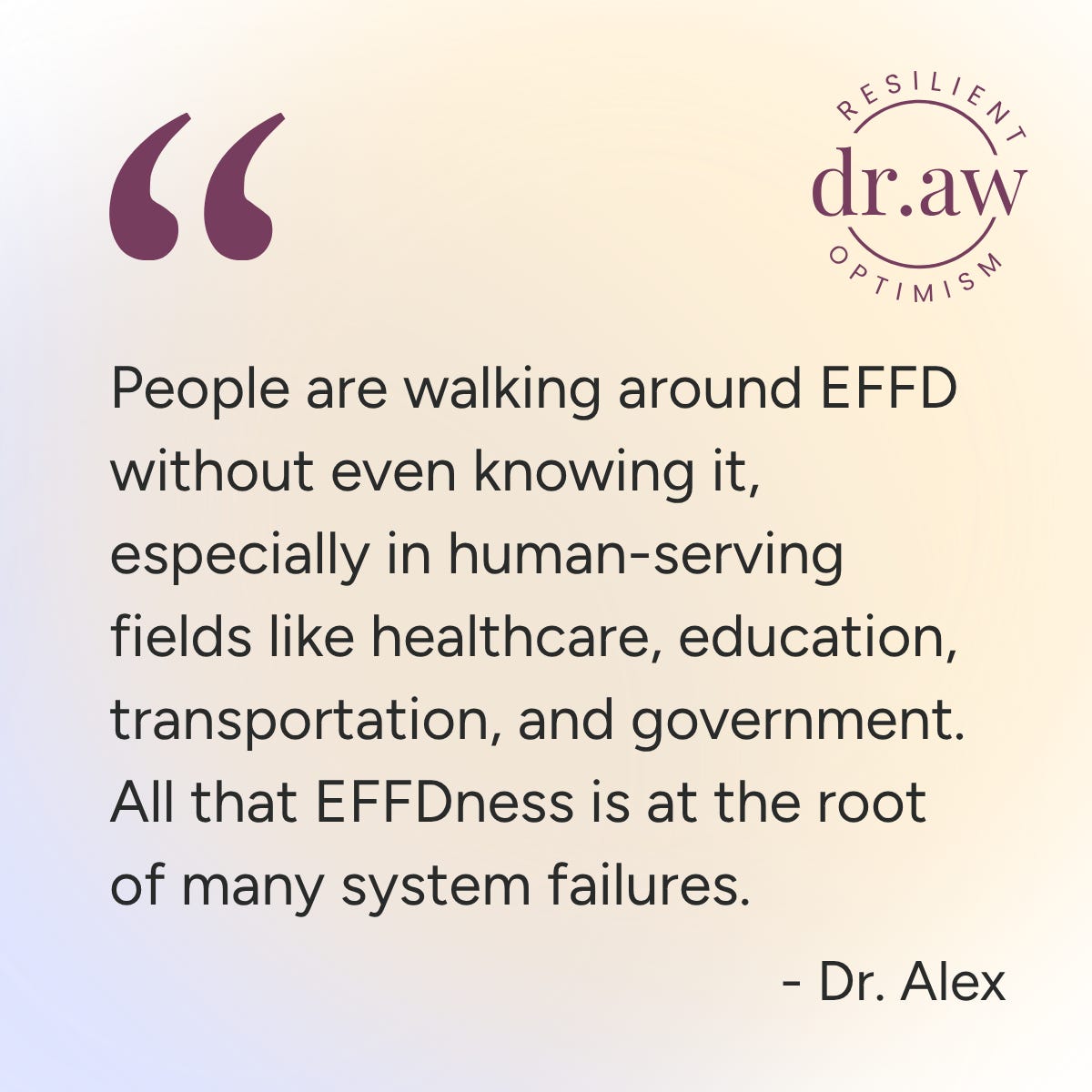
People are walking around EFFD without even realizing it, especially those working in human-serving fields like healthcare, education, transportation, and government, among others. I’d argue that all this EFFDness is at the root of many system failures, too.
To be clear, all of us experience feelings of exhaustion, frustration, fear, and defeat sometimes. Feeling those emotions does not automatically mean you’re EFFD. True EFFD is a combination of those feelings layered on top of each other for a meaningful period of time that results in a pessimistic mindset. Once those states begin to reinforce each other, something deeper starts to happen.
Your Mindset Narrows
When you notice you aren’t open to new, different ideas and can only see things one particular way, that narrowing is one of the biggest warning signs. When I’m EFFD, I can feel it in my thinking before I feel it anywhere else. I stop seeing possibilities. I become attached to problems. I mentally rehearse worst-case scenarios as though they are inevitable outcomes. I become more rigid, more reactive, and far less curious. When you lose curiosity, along with it goes openness, flexibility, experimentation, and connection, attributes that are critical for maintaining resilient optimism.
EFFD convinces you there is no point in exploring because you already know how the story ends. The tricky part is that this mindset masquerades as realism. In fact, when you are deeply EFFD, your perspective feels rational. You start hearing yourself say things like, “That’s never going to change,” “We already tried that,” or “I know how this goes.” Because those thoughts are grounded in real disappointments and real experiences, they feel absolutely true.
But what I’ve come to realize is that EFFD doesn’t only shape how you feel. It shapes what you are capable of seeing. That’s one of the reasons I have become so passionate about resilient optimism as a form of mindset care. Because when you are deeply EFFD, traditional self-care isn’t enough to restore you on its own. You can benefit from a hike, a massage, a yoga class, or a weekend away. I still believe those things matter. But when I am EFFD, those activities feel more like temporary relief than meaningful and sustainable restoration.
For more long-term relief, you have to work on how you think, the narratives you reinforce, and the perspective you choose to practice. That is where resilient optimism enters the picture, not as toxic positivity or pretending hard things are not hard, but as an intentional practice of interrupting the narrowing before it calcifies into burnout. It is the ongoing discipline of staying open, curious, and connected to possibility even when life, systems, and people give you plenty of reasons not to.

Being EFFD, or a combination of feeling exhausted, frustrated, fearful, and defeated, is the precursor to burnout. If you can support your mindset by expanding your point of view, you might avoid the fallout.
We’re All EFFD Sometimes. Here’s What You Can Do About It.
I don’t think the goal is to never become EFFD. I think the goal is to recognize it faster, to notice when your thinking is shrinking and your pessimism is turning into futility. It’s also the goal to remember that your mindset is not fixed, even when it feels convincing. There is a lot you can do to change your mindset for the better.
That realization changed my life because once I understood EFFD as a mindset state instead of an identity, I stopped treating myself like I was broken and unfixable. I started treating my mindset like something I needed to actively care for.
Take the EFFD Assessment
I’ve developed a number of mindset care practices to help you work on your own mindset, whether you are EFFD or not. They’ll be outlined in my forthcoming resilient optimism book and workbooks, but for now, you can take my EFFD quiz to see where you land on the EFFD to Burnout Scale.
Follow this link to take the 5-minute assessment on my website. Once you’ve completed the questions, I’ll send you a mindset care practice that will help you reduce feelings of EFFD and hopefully avoid burnout, too.
Burnout is a significant predictor of physical ailments such as type 2 diabetes, coronary heart disease, hospitalization due to cardiovascular disorder, musculoskeletal pain, changes in pain experiences, prolonged fatigue, headaches, gastrointestinal issues, respiratory problems, severe injuries, and mortality below the age of 45 years. The psychological effects include insomnia, depressive symptoms, use of psychotropic and antidepressant medications, hospitalization for mental disorders and psychological ill-health symptoms. Professional outcomes include job dissatisfaction, absenteeism, and new disability pension.
Salvagioni DAJ, Melanda FN, Mesas AE, González AD, Gabani FL, Andrade SM. Physical, psychological and occupational consequences of job burnout: A systematic review of prospective studies. PLoS One. 2017 Oct 4;12(10):e0185781. doi: 10.1371/journal.pone.0185781. PMID: 28977041; PMCID: PMC5627926.