Resilient optimism™ turns setbacks into stepping stones. It’s an unshakable belief that transformation is possible, even in systems like government, healthcare, and education that are built to resist big sweeping change. Resilient optimism is not blind positivity. It’s the practice of asking what could be instead of listing reasons why things can’t change.
How Did Resilient Optimism Come to Be?
In my first Substack post, I introduced you to Jerry and how his preventable gang-related death led me to become what I call “EFFD,” a precursor to burnout.
I was:
- Exhausted
- Frustrated
- Fearful
- Defeated
🎬 Check out my full video breakdown on what resilient optimism is and how to practice it in high-stress, human-serving systems.
And I was EFFD for a while. I’m talking months. After Jerry died, I was ready to quit my job in corrections and find a new career outside the criminal/legal system, where the people I knew wouldn’t needlessly be shot and killed. But with time and the help of a mentor, I simmered down. I began to see that I could only control what was in my purview, which was the 40 or so men on parole in the facility where I worked as a reentry specialist. I also saw that if I wanted to make systemwide changes and help people stay alive, safe, and thriving, I’d have to find my way to the decision-making table, and I wasn’t going to do that with all that EFFDness clouding my vision.
I didn’t know it at the time, but I was developing my philosophy for resilient optimism, a practice for breaking out of being EFFD through intentional mindset shifts that propel you toward creating bold and lasting opportunities.
It’s only been in the last few years that I’ve been talking about resilient optimism. Before that, I was collecting my thoughts about working to resist burnout, something I saw MANY of my colleagues suffer from. I took notes about what worked and what didn’t work to create change in organizations and to reach big, hairy personal goals. I dug deep into implementation science, something my partners at the Alliance of Community and Justice Innovation (ACJI) and I have specialized in since 2017.
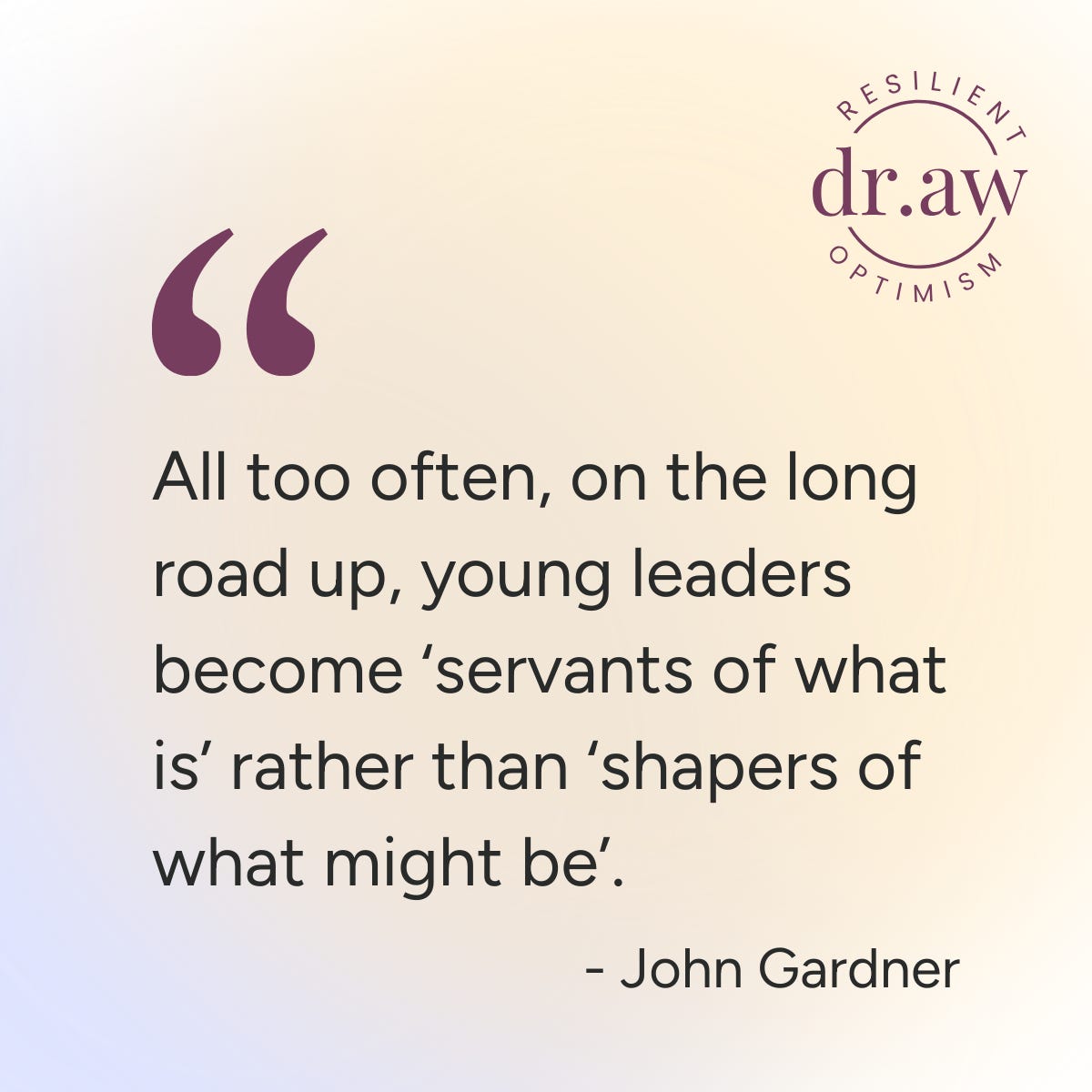
The catalyst for resilient optimism came when, in 2022, I was asked to give a keynote talk about fighting burnout to my colleagues in the corrections system. I immediately knew the quote I’d reference to set the tone. It was this one, from John Gardner, U.S. Secretary of Health, Education, and Welfare under President Lyndon B. Johnson. He wrote these words in his 1965 book, Self-Renewal: The Individual and the Innovative Society.
“All too often, on the long road up, young leaders become ‘servants of what is’ rather than ‘shapers of what might be’. In the long process of learning how the system works, they are rewarded within the intricate structure of existing rules. By the time they reach the top, they are very likely to be trained prisoners of the structure. This is not all bad; every vital system reaffirms itself. But no system can remain vital for long unless some of its leaders remain sufficiently independent to help it change and grow.”
Gardner’s quote is 60 years old and still so relevant. For me, it hits hard. I want to be “sufficiently independent to help [the criminal/legal system] change and grow.” I want all cultures, systems, organizations, teams, and people to change and grow, and I believe resilient optimism can help do that.
How to Become a Resilient Optimist
Resilient optimism is a skill, and that means it is learned. It is supported by science, too, which I outline in the book I’m working on, making it an even more potent antidote to burnout. To become a resilient optimist, you have to work at it every day, even when it feels hard. I’ve developed six practices to help you with that, which I’ll outline in future posts in more detail, but here they are at a glance.
The six resilient optimism practices:
Interrupt EFFD
Embrace failure
Focus relentlessly on what matters most
Seek different perspectives
Look for opportunities
Keep going
Practicing resilient optimism doesn’t erase pain or disappointment. It didn’t bring Jerry back. But it will transform how you stay connected to your work or passion without becoming EFFD and burnt out. It creates opportunity and hope for the future. It shapes what could be.
A practiced resilient optimism will:
Bounce back from setbacks faster
Adapt more easily
Lead naturally
Feel more in control when challenges inevitably arise
Gain energy, not lose it
Grow more empathetic and connected to those you work with and care about
Resilient Optimism Is Not Self-Care. It’s Mindset Care.
When people hit this wall, the standard advice is usually “do more self-care.” Take a vacation. Get a massage. Go for a walk. Do some yoga.
That’s all fine and well, but you can’t massage or vacation your way out of burnout.
Self-care is important, but it doesn’t change a mindset that is convinced nothing will ever change. Mindset care must come first. Resilient optimism is a form of mindset care. When you change how you interpret your experiences, your self-care finally has a place to take root. The way I see it, the two can and should work together to avoid EFFD and its big sister, burnout.
What’s Your Current EFFD Level?
If you’re curious about where your mindset is landing right now, I created a quick tool to help you check in with yourself.
👉 Take my free “Are You EFFD?” quiz here to discover your current level of EFFD. Identify which of the four areas—exhaustion, frustration, fear, and defeat—is impacting you most, and get practical tips to start shifting your spotlight today.
Thank you for reading and for following along. I’ll continue to share what I’ve learned about resilient optimism and share tips on how you can become a true resilient optimist, too.