

“You need to do some self-care.”
Raise your hand if someone has said this to you. Now keep it raised if they said it in the last week. In the criminal/legal system where I have worked for the last three decades, it’s said so much that it has become cliché. And if I’m being honest, I think it’s bullshit.
Not because self-care, as most of us currently understand it, doesn’t matter or that I don’t enjoy it. I think it’s BS because there have been times in my life and career when no amount of massage, journaling, bubble baths, or Netflix could help me navigate what was happening in my mind, nervous system, or my environment. When you’re burnt out or struggling with a traumatic experience, you can’t downward dog your way out of it. The suggestion that you could is insulting to me.
I didn’t always feel this way. When my kids were still itty bitty, I went to great lengths to squeeze in workouts and massages and self-help books. (Who with a newborn has the headspace to read?!?!?!?) I was determined to do self-care “right” even if it was really hard. But I was still stressed, short on time, and couldn’t get through two pages of the book without falling asleep. I judged myself for not feeling better. Why didn’t I feel restored? What was I doing wrong? I didn’t know.
But I Kept Trying…
In the mid-2010s, especially in leadership and professional development spaces, I began hearing more about meditation and gratitude journaling, two practices with strong data to support their efficacy in reducing stress and calming the nervous system. In fact, in this Mayo Clinic article, you’ll see how meditation and mindfulness reduce cortisol levels in our bodies, and that practicing gratitude for 10-15 minutes once a week can increase long-term satisfaction with life.1 In more recent years, breathwork, an ancient practice, began gaining traction in the Western world. There are dozens of approaches, and wow, does box breathing help me to create a pause in the chaos and bring clarity to my mind and calm in my body. But, like with all things, it must be done regularly to experience sustained results. I’d listen to guided meditations before sleep and had sticky notes on my dashboard reminding me to breathe deeply, but my dad still had a heart attack, and the people I met in those parole board hearings had still committed some horrendous crimes that stayed with me long after the hearings were over.
None of the self-care I employed was enough to keep me out of burnout. That tension is what eventually pushed me to rethink the entire concept of self-care.
Common Types of Self-Care
As I see it, most of what is called self-care falls into four categories:
Body
Pause
Service
Community
Body-Based Self-Care
Body-based self-care includes activities you instinctively reach for, like exercise, sleep, massages, dinner with friends, hobbies, and so on. These activities release endorphins and reconnect you to joy and to parts of yourself that don’t often get to come out to play in this chaotic, modern life of ours. All of that is real.
But if your mind is spiraling about a court case tomorrow, your rebellious teenager, or a decision that blindsided you, the body-based exercises are only a temporary fix.


Pause-Based Self-Care
Pause-based self-care includes meditation, journaling, gratitude lists, breathwork, therapy, and coaching. These activities help to interrupt thinking patterns and quiet “head trash,” those insidious stories taking up space in your mind about people and events based on incomplete information and your biases. You make assumptions about what others are thinking and catastrophize about what might happen next. This internal commentary is hard to control and, I mean, ugh. It is so exhausting.
Pause practices create space between stimulus and response. They help you notice your thinking instead of being swallowed by it. They invite the quieter, truer self to come forward from under ingrained expectations and habits.
There are so, so many benefits, supported by research, to pause practices:
Reduced stress reactivity
Improved emotional regulation
Increased open-mindedness
I will always include pause-based self-care in my routine, and would never tell someone not to, but here’s the thing: not everyone benefits from all types of it, and it can be hard to do. If you are agitated or in physical pain, sitting for 20 minutes with your eyes closed can make things worse.
When Pause Practices Go Awry
My co-writer, Sara, spent years struggling with a journaling habit that actually fueled her depressive tendencies. As a writer, she felt this practice was central to her identity. She knew journaling was helpful for processing emotions. But when she read back through years of journals, she saw the pattern. She saw how she was only ruminating on unhelpful thoughts that reinforced her distress for a very long time. By letting go of the pressure to journal, she felt lighter.
For me, I had some very scary experiences doing a special kind of meditation called yoga nidra. I’ll cover that experience in another Substack, but let’s just say, I’d start to fall into a meditative state with a yoga nidra guide, and some horrible images would show up in my mind. It got so bad once that I swore it off altogether. It wasn’t until I spoke with an expert about it that I understood these images were a consequence of the vicarious trauma I experienced on the parole board.
I give you these examples to illustrate that some forms of pause practices have limits, shaped by your mental and physical health and life experiences. Take care to know that if pause practices, or any specific type of self-care practice, are difficult for you, it doesn’t mean you are doing it wrong. And you’re not alone!
Acts of Service as Self-Care
When you give to others, you invite a shift in yourself. You step out of your own looping narratives and connect to meaning. Whether it’s mentoring a colleague, volunteering for a community organization, or holding a door open for an elderly neighbor, it’s an opportunity to be part of something larger than your current situation or frustration. Research consistently shows that acts of service not only benefit the receiver but also the giver, increasing well-being and reducing depressive symptoms.2
And yet, when you are exhausted or frustrated, service might feel like the last thing you have capacity for. It can feel counterintuitive to give when you feel depleted. But trust me. More often than not, your outward focus will recalibrate you in powerful ways, especially if your mindset is in check.


Community as Self-Care
Community, or spaces with people where you are known in your vulnerability and don’t fear rejection, helps to fill a fundamental human need for connection. When you are struggling, it’s tempting to withdraw from your communities. You tell yourself that you will re-engage once you have more to offer and are less messy. But the paradox is that community is what helps us become less messy. We are social beings, and our perspective expands with dialogue. Being witnessed in our vulnerability reduces shame and increases resilience.3
I’ve heard from many people that they don’t know where to find community. As someone who lives in a rural area, I get it. The trick is to get creative. Start hosting regular game nights and ask your guests to bring a friend. Join a yoga studio or fitness club and commit to going regularly to the same classes. Find an online support group for what ails you. Think outside the ordinary and make yourself uncomfortable. It takes time to have an authentic connection, so try to have patience, too.
The 5th Type of Self-Care, Mindset Care Practices
All those years of trying different self-care strategies, and I still struggled with difficult relationships and navigating a high-stress career. Over and over again, my real question came down to this: How do I show up more regulated and more myself in the moment when adversity spikes?
This is where the mainstream self-care conversation fell apart for me. Prevention is one thing, and acute adversity is another. And if you work in prisons, hospitals, courtrooms, classrooms, any kind of human-service setting, or just exist within a family system, adversity is not the exception. It is the constant.
Enter: resilient optimism™
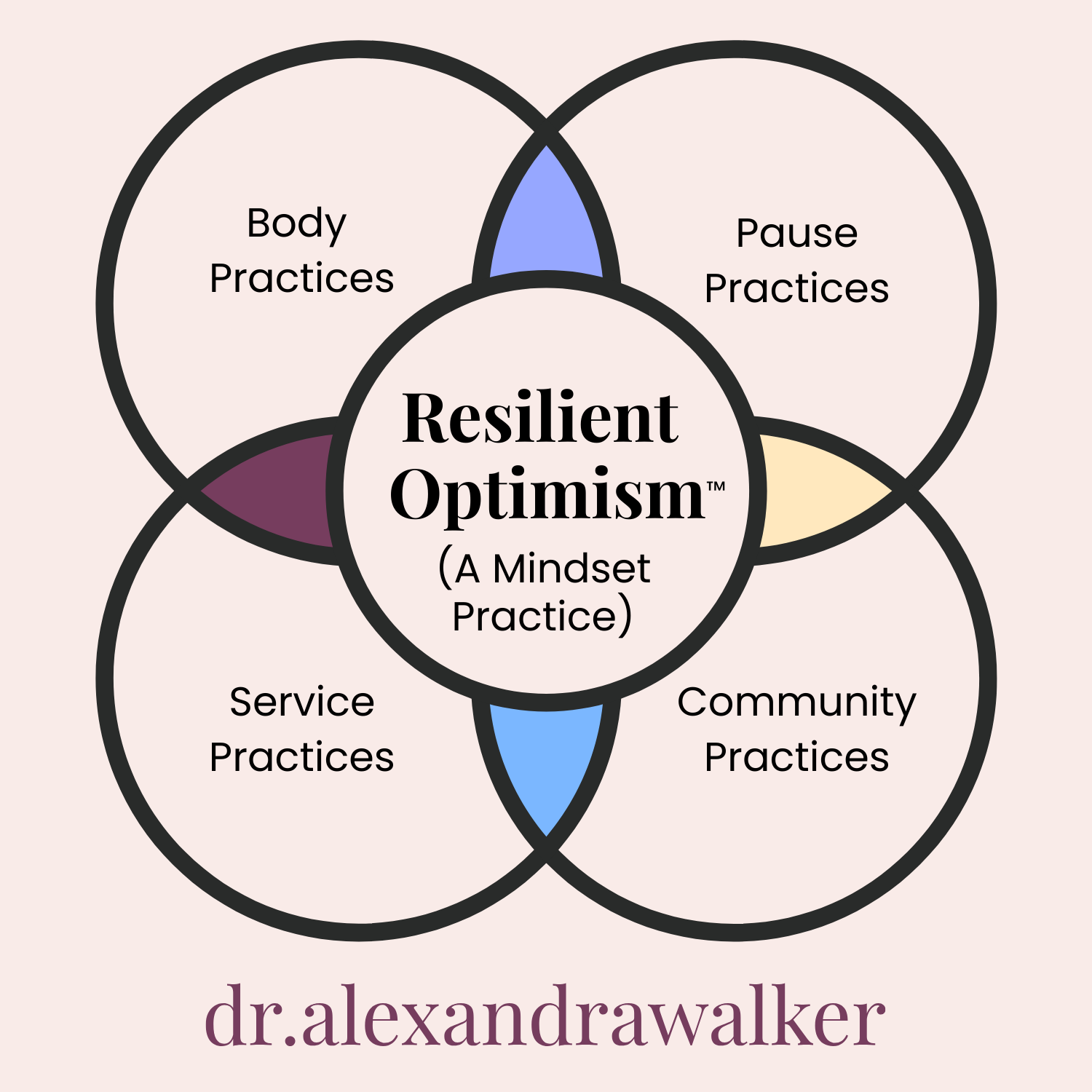
Resilient optimism is not positive thinking or the belief that everything happens for a reason. It is an intentional, long-term mindset care practice that I’ve developed to help me, and now you, build a mindset you can rely on when traditional self-care is not immediately accessible. In other words, when a conversation goes sideways, and you are tempted to overreact or shut down, with practice, you will have the words at the ready to navigate the difficult conversation. You will come to know yourself well enough to anticipate that you’re likely to lose your temper or check out, so you say, “I don’t want to be defensive. I want to work through this with you.” No harm, no foul. It’s a practice that doesn’t allow adversity to ruin your day or send you spiraling.
You still go for a walk to reset your nervous system, and you still write in your journal to process your feelings about the argument, but because of the mindset practice you’ve developed, you more readily see a way forward without more unnecessary stress and discomfort. You don’t get stuck in the problem. You move toward what is possible. That’s what being a resilient optimist looks like.
Too much stress and discomfort without the proper means of navigating will push you down the slide of what I call EFFD, the precursor to burnout. It’s called EFFD for two reasons. One, it stands for exhaustion, frustration, fear, and defeat. Two, if you let it take hold and you fall into burnout, you will be f*&#ed. In my opinion, burnout is greatly underappreciated. It costs big business millions of dollars, and the cost to individuals is unquantifiable, given the time it gobbles up, the relationships it affects, and the physical and mental health consequences. What little we do talk about burnout mostly focuses on what to do when you are actively in it, not preventing it. If we want more people to enjoy their lives and stay passionate throughout the ups and downs of their careers, there needs to be conversation BEFORE burnout is a problem. We need to recognize symptoms of EFFD when they start. But that’s a topic for another Substack.
With resilient optimism, which I talk about more explicitly in this earlier article, you learn how to adapt, bounce back quicker after adversity, get an energy boost, and gain a healthy sense of control so you can regulate your body before reactivity takes over. This helps you to recognize EFFD symptoms and stay clear of burnout. It also helps you achieve big dreams and goals because it centers you around shaping what could be, not getting stuck in what is.
The Full Self-Care Picture
Body practices give you a biochemical lift
Pause practices create space between stimulus and response
Acts of service shift your focus outside of yourself and expand your perspective
Community creates belonging and increases vulnerability, which reduces feelings of shame and loneliness
Mindset care, or the six intentional practices of resilient optimism, creates a disciplined shift from feeling defeated to finding where you still have the power to act
Resilient optimism is the deliberate cultivation of a mindset that can navigate complexity without collapsing. It is what gets you through daily challenges, so that when you have the space to engage in traditional self-care, you have more room to do so and can get more out of it, too. The benefits of exercise, meditation, service, and community last longer when they land in a grounded mindset, where all self-care practices can reinforce one another rather than operate as isolated interventions.
For me, all those years when I was practicing self-care and still feeling so close to burnout, the problem wasn’t that self-care wasn’t working. The problem was that I was asking self-care to do a job it was never designed to do on its own.
For an inside look at the six specific resilient optimism practices, sign up to be notified when my forthcoming book on Resilient Optimism is available. I’ll also be posting more here on Substack and on Instagram. I’m just getting started and can’t wait to share with you all of the things I have learned in my studies and experiences working in the criminal justice system.
Diniz, G., Korkes, L., Tristão, L. S., Pelegrini, R., Bellodi, P. L., & Bernardo, W. M. (2023). The effects of gratitude interventions: a systematic review and meta-analysis. Einstein (Sao Paulo), 21, eRW0371.; https://www.mayoclinic.org/tests-procedures/meditation/in-depth/mindfulness-exercises/art-20046356
Fryburg DA. Kindness as a Stress Reduction-Health Promotion Intervention: A Review of the Psychobiology of Caring. Am J Lifestyle Med. 2021 Jan 29;16(1):89-100. doi: 10.1177/1559827620988268. PMID: 35185431; PMCID: PMC8848115.
Fryburg DA. Kindness as a Stress Reduction-Health Promotion Intervention: A Review of the Psychobiology of Caring. Am J Lifestyle Med. 2021 Jan 29;16(1):89-100. doi: 10.1177/1559827620988268. PMID: 35185431; PMCID: PMC8848115.
Very good article Dr Alex Walker. I am signing up to be notified of when your new book, Resilient Optimism, comes out.