Meditation has always been a struggle for me. I’ve long wanted to be someone who could sit quietly, close my eyes, and access that calm, luminous steadiness that wellness culture seems to promise.
Instead, I wrestle with nonstop thoughts. I try to focus on my breath, and then my thoughts multiply. I replay conversations, draft emails in my head, reorganize tomorrow’s schedule, or mentally solve problems that do not need solving in that moment.
I usually try for a few weeks, grow frustrated, give up, and then return again when life feels overwhelming enough to justify another attempt. Several years back, someone suggested I try yoga nidra, or yogic sleep, a guided meditation practice. I was told it promotes deep relaxation while your mind remains active. Sign me up, I thought! I was drawn to the structure of it and the idea that I wouldn’t have to generate the calm on my own, that someone’s voice would guide me there. I really wanted it to work.
What Happened Instead Terrified Me
I was lying in a dark yoga studio, following the teacher’s voice through a slow body scan. My awareness moved from my toes to my legs to my torso while my breathing continued to slow. Brooke, who happens to be one of my favorite teachers, then invited us all to notice when thoughts and images arose and let them float by.
Almost immediately, my mind filled with violent scenes like a child with a noose around her neck and dead birds littering the side of a road. These images came quickly and vividly, as though a door had opened inside me without permission. I remember thinking, with a kind of cold clarity, that something is deeply wrong with me. I left that session shaken, convinced that yoga nidra had unlocked something dangerous inside my psyche.
Then I did what most of us do when something scares us. I avoided it and judged it. I constructed a narrative about yoga nidra and told myself I simply wasn’t built for it. I did not think it was a safe place for me to go, and I swore I would never do a nidra again.
For a long time, I carried that experience privately. I did not want to say it out loud because doing so would confirm my fear that those images were evidence of something dark and ugly inside of me. The story I created leaned heavily toward shame. It suggested that the problem was not the practice but the person lying on the yoga mat who was capable of thinking horrible thoughts such as those. I mentioned it to Brooke over coffee once, but I felt so uncomfortable that I simplified the explanation: “I just don’t like nidra.”
Then, years later, on a retreat led by her in Taos, I took a look at the agenda and saw there was a planned nidra every single day. My stomach dropped when I saw it. I planned to quietly excuse myself, hoping to slip away unnoticed, but when I prepared to do so, she noticed, of course, and gently asked why. There was no graceful exit, so I quickly explained what had happened years before.
What Was Really Happening in My Brain During Yoga Nidra
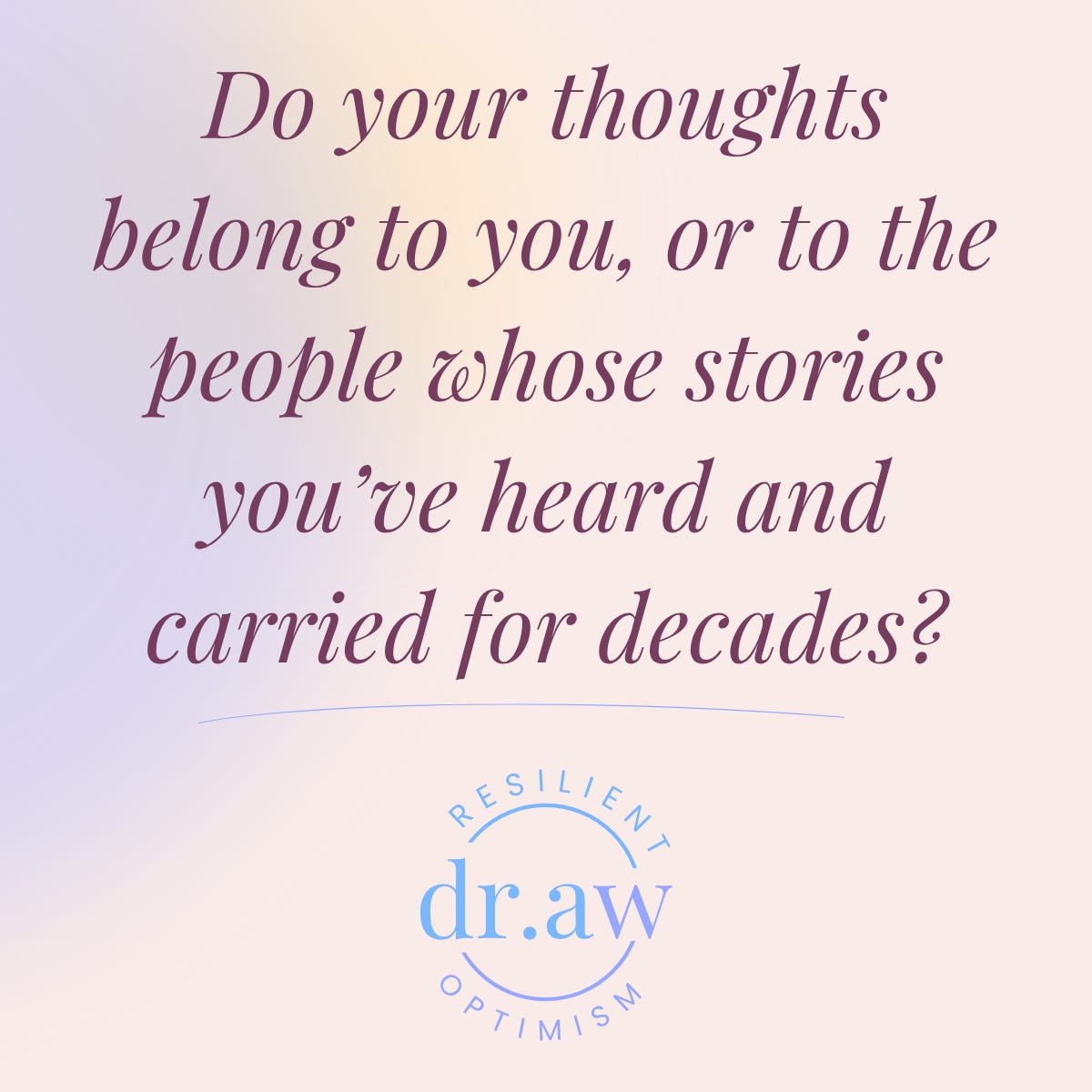
As we were talking, Brooke’s brother, Ashton, overheard. He had been getting to know me throughout the day and knew about my work in the criminal legal system. He knew about the years I had spent inside prisons, in courtrooms, in spaces where people told stories of violence, loss, trauma, and harm. He listened carefully as I described the images that had surfaced during that first nidra. When I finished, he paused and asked one simple question: “Do you think those thoughts belong to you, or to the people whose stories you’ve heard and carried for decades?”
The question landed, and everything shifted for me. The images that had once felt like proof of something broken inside me suddenly made sense in a different way. They were not evidence of personal darkness. They were residues of stored, unprocessed traumas that I bore witness to. My nervous system had been doing exactly what nervous systems do when exposed to repeated trauma, even the vicarious kind: absorbing, filing, and holding material that had never been fully metabolized.
About vicarious trauma. It is when someone else’s trauma or traumatic story becomes part of your own worldview. Common in personal relationships and therapeutic relationships.
Those thoughts were not mine in the way I had assumed. They were echoes of stories I had held with compassion but perhaps never fully released. On my own, I would never have seen that. Left to my own interpretation, I had narrowed the meaning down to one painful explanation: something is wrong with me. It took another’s kindness to widen the frame. It took someone else reflecting back a possibility I had not considered.
I Needed Another Perspective
The fourth Resilient Optimism practice is Explore, and it’s all about seeking different perspectives and getting curious. My experience with yoga nidra is an example of what exploring looks like in the practice of resilient optimism. It is rarely comfortable. It requires honesty about what is happening internally. It requires the humility to admit that the story forming in your mind might not be the whole story. And it often requires other trusted, thoughtful people to help you see what you cannot see on your own. That’s what Ashton was able to do for me.
Without him, I would have stayed in avoidance and simply added yoga nidra to the growing list of meditative practices that “don’t work for me.” I would have missed the deeper truth that I had been carrying more vicarious trauma from my work than I realized. I would not have done the work to process that trauma and release its weight.
But simply knowing that those images weren’t really mine wasn’t enough to make them disappear. What that realization did do, however, was soften the fear enough for me to try again. The anxiety that something was fundamentally wrong with me began to loosen its grip. Instead of seeing yoga nidra as dangerous, I began to see it as a way to uncover what is buried.
I became deeply bothered by the idea that I was walking around holding other people’s trauma inside my nervous system. I had listened to those stories with care. I had witnessed them with compassion. But I had never intentionally processed or released them, and I had come to understand that my mind and body had simply stored them.
I wanted them out. Not because I wanted to forget the people whose stories I had heard, but because I knew carrying their pain indefinitely was not the same thing as honoring it. And strangely, the only place those memories seemed to surface was in yoga nidra. I had never experienced flashbacks during the day. I didn’t walk around haunted by the details of other people’s lives. It was only during nidra, in that in-between space, that images surfaced.
So instead of avoiding it as I did before, I leaned into it. If that was where the stored material surfaced, then that was where the work needed to happen.
Brooke later explained that yoga nidra mimics aspects of REM sleep, the state where our brains naturally process and integrate experience. In other words, the practice was not creating the images. It was simply creating the conditions where my brain could finally process what had been sitting in storage for years.
Ashton helped me understand something equally important: the brain doesn’t neatly distinguish between our experiences and the stories we absorb from others. When we bear witness to trauma repeatedly, especially in emotionally charged environments, our nervous systems can carry those experiences as if they are our own. They can imprint on us without us ever realizing it. For those of us who are empathic by nature, that imprinting can be even stronger.
The body, however, has an incredible capacity to heal. As Brooke reminded me, there is an innate healing intelligence within us that knows how to process difficult material when given the space to do so.
The Role of the Yoga Nidra Facilitator
The role of a skilled yoga nidra facilitator is not to fix or control that process, but to hold the energetic and relational container where it can unfold safely. I think the same is true for any program facilitator or even a mental or behavioral health practitioner. In fact, Ashton shared that research suggests as much as 85 percent of the effectiveness of a therapeutic experience comes down to the quality of the relationship itself. The sense that someone is holding space for you while you do the work your system already knows how to do.
That’s exactly what Brooke was doing in those nidras. Her calm presence, steady voice, and the trust I had in her created the conditions where my nervous system could finally begin to metabolize what it had been holding.
Through my time with Brooke and yoga, she has also introduced me to the concept of chitta chatter, the constant stream of mental activity that moves through our minds each day. Some research suggests we may have as many as seventy thousand thoughts daily, most of which pass through unnoticed and unremembered. But when trauma, whether our own or borrowed from others, lives in that stream, it can shape our internal landscape in ways we don’t fully understand.
What surfaced in those early nidras was not evidence of something broken in me. It was evidence that my mind had been trying to process something for a very long time.
So I kept going.
I returned to nidra again and again, not out of fear but out of curiosity. Each time an image surfaced, I practiced letting it move through without attaching meaning or shame. Slowly, the intensity softened. The images came less frequently. The chatter quieted. And eventually something unexpected happened. The practice that once terrified me became a place of deep peace.
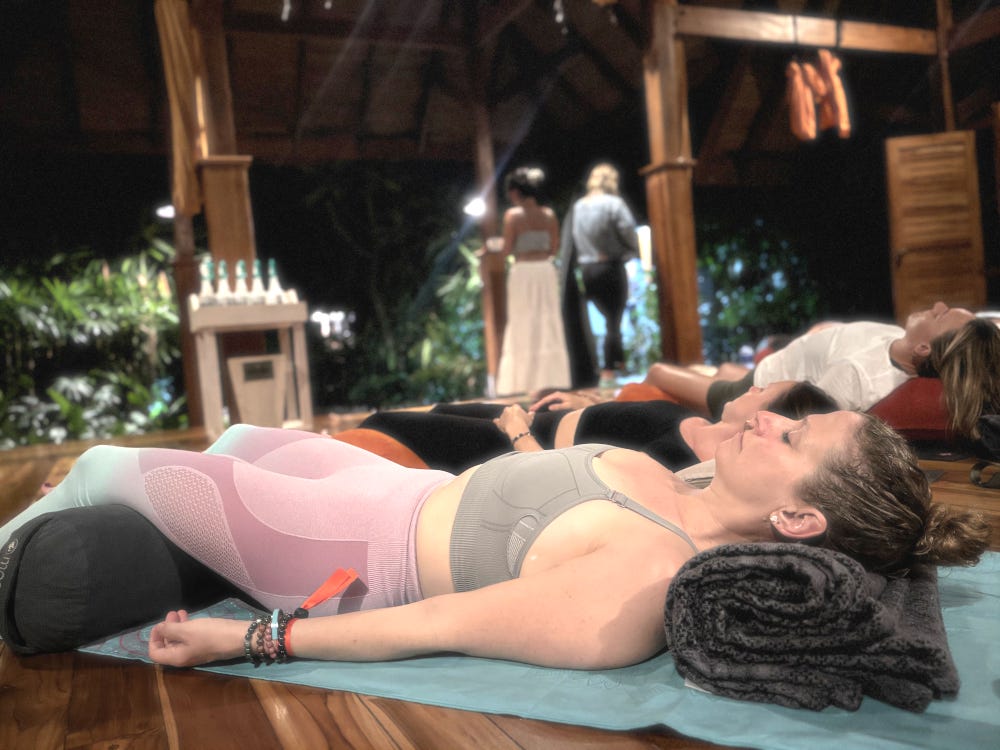
Here I am in a supported savasana at one of Brooke’s retreats in Costa Rica. You know how I love my self-care!
How Yoga Nidra and Resilient Optimism Tie Together
When we are left alone with our interpretations, our brains tend to offer us the smallest possible version of the truth. A version shaped by fear, loyalty, experience, and unconscious bias. The brain is efficient. It fills in gaps quickly. It generates explanations to keep us safe. But those explanations are often incomplete, and without expansion, they calcify.
Resilient optimism interrupts that narrowing. It invites us to ask what else might be true. It encourages us to seek voices that can help us reframe what feels frightening or fixed. In my case, what I initially interpreted as evidence of danger was actually evidence that bearing witness has weight. Exploring what I was experiencing with others helped me step through the fear and begin a journey of deeper restoration.
Gratitude
This experience, and the reflections in this article, were shaped by conversations and experiences with two people who have profoundly influenced my understanding of yoga nidra, trauma, and healing.
Brooke Page-Thompson
Yoga teacher, RYT-500 and I AM Yoga Nidra Advanced Facilitator
IG: @bukayoga | @finding_the_pause
Email: brooke@bukayoga.com
Brooke has an incredible ability to hold calm, thoughtful space for deep internal work. Her guidance through yoga nidra helped create the conditions where my nervous system could finally begin processing years of stored material. Her studio, Buka Yoga, is overflowing with opportunities for healing, growth, and restoration. Over the last four years, she has hosted regular sound baths for a community of women that I adore, and we are ever so grateful.
Ashton Page
Artist and Clinical Social Worker (Omaha, NE)
IG: @boy_in_rainbows
Email: hello.ashtonjpage@gmail.com
Ashton asked the simple question that reframed my entire experience and helped me understand the role of vicarious trauma in what surfaced during nidra. His calm and inquisitive demeanor is such a gift for so many.
I’m deeply grateful to you both.